
Image gallery
Click on any image to enlarge.
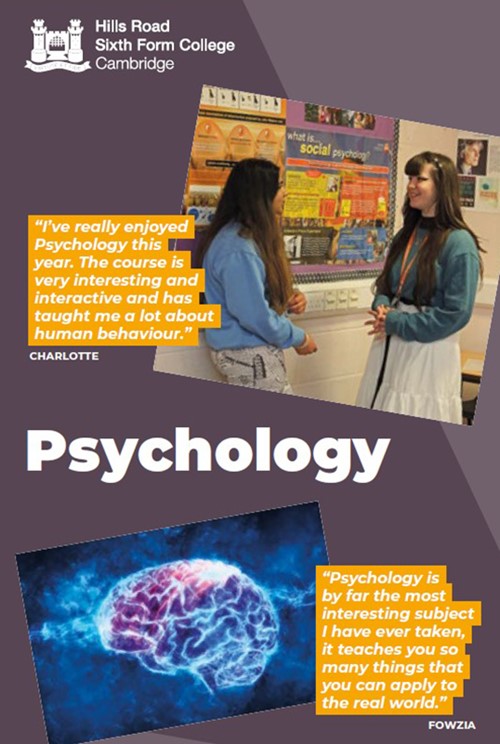

A Level Psychology
Hills Road Sixth Form College
Hills Road, Cambridge, Cambridgeshire, CB2 8PE
Available start dates
Available start dates
Course Summary
A fascinating subject with a rigorous and scientific approach.
Psychology is the scientific study of human behaviour and experience. This stimulating subject combines fascinating content with a rigorous and scientific approach to investigation. It has recently undergone a huge growth in popularity.
About the Course
The course aims to develop both an academic understanding of the subject and an appreciation of its impact on people's daily lives. Psychology A level develops your ability to formulate an argument by presenting and critically evaluating research evidence. Accurate and concise writing is important in answering short structured questions and longer essay style questions. There is no coursework, but an important element of the course is practical: designing and carrying out research, reporting findings and analysing data. This provides good opportunities to develop IT and number skills. Lunchtime workshops and a peer mentoring scheme provide further opportunities to further your understanding. There is a student-run Psychology Society which organises lunchtime talks by visiting speakers. You will have the opportunity to take part in university research, to visit Bethlem Museum of Mind in London and to attend conferences consisting of lectures by academic and practising psychologists.
Course Details
You will study the following topics. For each, some indicative content is included:
Social influence: conformity to the majority, obeying evil authority figures, resisting these influences, explaining social change.
Memory: models of memory and forgetting, eye witness testimony, police interviews.
Attachment between babies and caregivers: attachment problems and lifelong effects.
Psychopathology: biological, behavioural and cognitive explanations and treatments of OCD, phobias and depression.
Approaches - the 'big ideas' which explain behaviour from different perspectives: biological, behavioural, cognitive, psychodynamic and humanistic.
Research methods: experiments, observations, sampling, design, presenting and analysing data, ethical issues, psychology as a science.
Biopsychology: functions of different brain regions, recovery after brain damage, brain scans, bodily rhythms, the sleep/wake cycle.
Issues and debates: gender & culture bias, nature v nurture, free will v determinism, ethical implications of socially sensitive research.
Relationships: why they last and what happens when they don't, evolved partner preferences, virtual relationships and 'relationships' with media personalities.
Schizophrenia: symptoms, diagnosis problems, genes, brain chemistry, faulty thinking, dysfunctional families, therapies, drugs, family and CBT.
Forensic: offender profiling, measuring, explaining and dealing with crime.
How will it be delivered and assessed?
Entry requirements
You need to be qualified by both the 1) relevant admissions score AND 2) for the subjects you are applying for:
1) Admissions scores
The indicative Minimum Entry Admissions Score for Psychology is 58*
Calculate your admissions score at www.hillsroad.ac.uk/calculator
Read more about our admissions scores by visiting www.hillsroad.ac.uk/apply
2) Subjects and grades required
GCSE grade 6 in English Language or 6 in English Literature, and 6 in Mathematics or one Science
Before making your application, visit www.hillsroad.ac.uk/apply and give yourself the best chance of achieving our entry criteria.
*The admissions scores are an indicative guide to help applicants understand how places have previously been allocated, they should not be taken as a definitive prediction of equivalent scores for entry to the College in 2022, which will depend on application patterns for that year. Please submit your application to the College even if your score is a few points below the relevant admissions score.
Your next steps...
Psychology A Level is a very useful basis for a Psychology degree. This is a well-respected degree for many occupations which require graduate status, and also opens up opportunities to work for example as a clinical, sports or forensic psychologist.
Additional information
For more courses like this, check our courses page.